Showing posts with label mark rippetoe. Show all posts

Monday, November 28, 2011

Day 59 of 365: Pressing The Pressing Issue


This week at CrossFit Central, our athletes are crankin' on the CrossFit Total. 
If you don't already know, the CrossFit Total is comprised of 3 lifts:  The Back Squat, the Shoulder Press, and the Deadlift. 

  
In each of the lifts, the athlete is attempting to set new 1RM maxes that will be summed and Totaled (Get it?) for a resulting score equal to the pounds lifted.  The Total is the way we test an individual's overall strength, which I'm sure you probably guessed by the selection of the exercises, right?

It's funny, though.  As I watched my athletes take on each lift, I realized that the lift that  they were having the most trouble with was the the shoulder press - by far the most simplistic lift...on the surface, but we are about to dive a bit deeper to uncover why the press is the hardest movement to improve on.  You ready?

Alright. So to start us off on the right foot here, I am going to show you a video.  This is pretty much the way I teach the press, minus a couple points that we will hit a bit later.  Watch this and you'll be up to speed.


 Seems pretty straight forward, right?  Well, let's quickly make a checklist of the basics:

1. Grip right outside of shoulders(make sure it's symmetrical)
2. Unrack the bar by creating a platform with your anterior delts(front of your shoulders)
3. Set your feet at hip-width, squeeze your butt, quads, and abs as tight as possible.  This creates a rock-solid foundation to press from.  VERY IMPORTANT!!!
4. Lift your elbows so that your forearm is completely vertical.  Basic rule here is that your forearms need to point in the direction you want the bar to go; straight up and slightly back.
5. Take a quick, deep breath just before initiating the press.
6. Drive the bar straight up keeping it close to your face and forehead.
7. Once the bar has cleared your forehead, press slightly backwards while also driving your upper-body under the bar.
8. Lock the B#tch out!!!

So now that we have a basic understanding of what needs to happen to succesfully perform a quality press, here's the one major idea that I want you to grasp:   
BARBELL SPEED!!!
We have discussed this before, but when performing any lift, the athlete has a specificed timeframe in which he or she can make the lift.  Any slower and the bar will stop dead in it's tracks and leave you in no-man's-land, wondering what the hell just happened.
Here's the deal.  Once you have set up and you are rock-solid in that position, you must maintain it as you punch that bar towards the ceiling...making it a point to keep the bar path as close to your face as possible!  This deliberate effort to move quickly will ensure that that nasty little thing called GRAVITY doesn't catch hold of that bar - closing that window of possible PRs.

So, next time you hit some presses, focus on the details of your setup, the bar path, and especially your speed!!!  You will find that the press, when done with these things in mind, is not as simplistic as you originally thought....BUT, you will also realize that there is a ton of POWER and STRENGTH hidden in those details!!!
GO GET IT!!!

Wednesday, September 15, 2010

DEADLIFT = FREAKISH STRENGTH

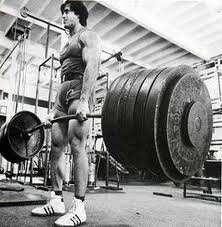
The Deadlift is a seemingly straight-forward exercise.  But sometimes, we can underestimate the amount of focus it takes to perform a perfect rep, and we often forget how much work the body is actually doing for each successful repetition.  This is all compounded when the barbell is loaded for a PR attempt.  So it is extremely important that we understand the mechanics of a proper deadlift so that when we train at relatively lighter weights, we develop extraordinary form!


There are 3 very simple, but integral parts to the starting position of the deadlift, as pointed out by Mark Rippetoe:

1) The back must be locked in extension.
2) The bar must be touching the shins, with the feet lat on the floor.
3) The shoulders must be out in front of the bar so that the shoulder blades are directly above the bar.
These 3 checkpoints are easy enough to follow, but why is it so necessary that we follow this protocol?  
Let's take this one at a time...

These are all the muscles that create a rigid spine, plus some!
1) The back must be locked in extension.
Weightlifting is all about the translation of force when you simplify it.  A well-performed rep is basically the force you apply to a foundation - in this case, the floor - being efficiently translated to the object you're attempting to move - the barbell.  The mechanism by which this energy is translated and transferred to the barbell is a rigid, unified spine.  As we all know, the spine is a collection of many joints.  By design, these joints allow us to move in many different ranges of motion, which is very advantageous in the "day-to-day".  But, when we try to pick something up without locking our back in, energy is lost from one joint to the next, causing a failed rep and an increased risk of injury.  When the spine is pulled into a single, rigid unit, the energy we create is efficiently transferred from floor to bar, and the risk of injury is virtually zero!  Think of the spine(when locked in)as a highly conductive cable for force rather than electricity.  If the spine is not locked in, the energy transfer is broken and weak.  We should get by now, right?  Let's move on...


2) The bar must be touching the shins, with the feet flat on the floor.
This is another very simple, yet often neglected requirement for a solid deadlift.  I know the athletes in my classes probably get sick of me saying, "Make sure the bar is IN CONTACT with your shins!"  But here's the reasoning...
I want you to use your imagination for a second, and picture yourself standing tall and holding a 35# dumbell directly out in front of you with your arm fully extended parallel to the floor.  Got it?  Most of us could handle that, right?  Now, magically, a large fishing net with a 5ft. handle became available.  You have put that same 35# dumbell in the net, and have extended it out in the same fashion as before.  Do you think you could lift it?  Probably not.
This is the basis of the "bar in contact with the shins" rule.  Naturally, due to gravity, objects have more torque acting upon them when they are lifted using a longer lever-arm, which seemingly makes them feel heavier.  Keeping the barbell in contact with your body throughout the movement is yet another way that your application of force is efficiently translated to the object.

3) The shoulders must be out in front of the bar so that the shoulder blades are directly above the bar.

This one is not so easy to understand, but I will give it my best effort and then refer you to Mark Rippetoe's article in the CrossFit Journal for some supplemental reading.
Now that we understand that force is being conducted from the floor, through our legs and hips to our spine, we can go one step further.  The energy we've created is transferred from the spine to the scapulae(shoulder blades), to the arms, and finally to the bar.  So, the shoulder blades are like a translator bridging the gap from one language to another.  When the shoulder blades are actively pulled back and together, the trap muscles are now doing a lot of work stabilizing the shoulder position, as well as assisting other muscles in locking in the spine.  More importantly to note, is the fact that gravity is acting on the bar in a linear fashion - meaning gravity is pulling it straight down to the floor.  Now, to effectively counteract the force of gravity, we must position ourselves so that our force is being translated directly opposite that of gravity - straight above the bar.  Makes sense, right?


Just think.  This whole blog is all about the start of the deadlift!!!  Actually, if you set up properly you've pretty much got it made!  The only thing now is timing and proper muscle activation, all of which happens fairly naturally after the initial pull.  Just stand up and keep the bar tight to the body...

As you can now tell, there is a lot of biomechanics and physics that goes into having a solid understanding of weightlifting.  It is to your advantage, as an athlete, to have some understanding of why we do what we do.  This understanding will lead to increases in weight lifted, guaranteed!!!  Who knew reading could make you physically stronger?  
Go get it!!!