Showing posts with label deadlift technique. Show all posts

Thursday, December 1, 2011

Day 62 of 365: Don't Be Afraid To Grind.

Alright.  Alright.  Get your mind out of the gutter, people!
  
We are not going to be discussing that type of grind, but rather the grind you find yourself in when you're pulling a huge deadlift.  Not quite as enticing, but stay with me here.  
I promise it's worth it.

My good friend and training partner, Michael Winchester sent a link to me today to a article on T-Nation that is worth a read!  Check it out HERE. 

As I read it, it got me thinking...
"Do people even know what it is to fight through a deadlift repitition?"
I found it scary and a little sad to think that there are those of you out there that have never actually fought for every inch of something so seemingly meaningless as a deadlift.

I hope that you all have had the experience of a 10 second deadlift.  For those that haven't yet, these "grinding" reps are the longest, toughest, and most humbling experiences you can imagine.  I remember the most epic pull I've ever had - at the time, it was a PR lift of 385lbs.  I got myself jacked up and went right for it.  I started the pull, the bar slowly broke from the floor, and where most deadlift become easier as the momentum builds, on this occassion, it did NOT.  It seemed as though the bar was slowing down with every inch.  Although the speed was painfully slow, I was not going to give up!  What felt like 30 minutes passed and I was now at the top of my knees with a long-ass way still to go! I hit several sticking points along my thighs that resulted in what I like to call, the "jack-hammer effect".  This, as you can imagine, is when your body begins to quiver and bounce around uncontrollably under the shear load and stress of the movement.  Pretty hilarious stuff when you see someone start convulsing like they've just stuck there finger in an electrical socket.  But, again, I was not going to be stopped.  I finally reached the top of the lift, where I quickly dropped the bar to the floor so that I would be able to catch myself if I were to pass out.  I saw my own personal light show with all of the stars I was seeing when it was all said and done.

Almost

Now, you may be asking yourself, 
"Why would anyone want to keep lifting at that point?"
"Why does this crazy bastard want ME to have this experience?  It sounds horrible!"
Let me be straight with you...It is absolutely horrible!  It really is.  But, it is also one of the most rewarding and most symbolic experiences you can have.  You see, you just fought through hell to lift a silly-ass bar off the floor.  That has to be one of the dumbest things to fight for, right?   
NO!!! 
It would have been so easy to just say, 
"This is too heavy!"  
"I can't do this!"  
"Today's a bad day."  
"I'll try it tomorrow."
BULLSHIT!  
If you don't fight for yourself and your strength, you will never fight, and you will never have the strength required to live an OUTSTANDING life. 

So next time that bar doesn't break off the floor as easy as you had hoped - 
DO NOT STOP!  
You are fighting for something bigger than a PR.  
Remember that!

Saturday, November 19, 2011

Day 50 of 365: Roadmap to SillyStrong - The Back Squat

YO!!!

Today, I spend about 2 hours creating informational/instructional videos on how to perform the BIG lifts that anyone serious about getting big and strong needs to hit on a regular basis.  I gotta say, as weird as it sounds, it was pretty fun spending time in RedBlack Gym on my own cranking this content out!  I guess I really am a meathead.  I good with that!
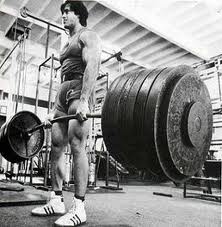
Can you tell which famous meathead this is?!
Anyway, today's movement - the back squat - is a foundational piece to any program.  
I'll say this: 
If you're not performing some form of squat everyday, you are failing!  
Mix it up and GET ON IT, STAT!!!  
Here's how:

Now, I know that in the video I said that we would be discussing the Box Squat as well, but I am going to wait until tomorrow to unleash that info on you.  I want you to absorb the info that I've given you for today so that you are ready to really pick up on what goes down tomorrow, because, as far as I'm concerned, the box squat is in fact more important than the back squat....
Tomorrow, we will discuss why?  
Be sure to tune back in for that!  
LATA!

Thursday, October 6, 2011

Day 6 of 365: Upping Your Deadlift IQ - Pt.2


Alright.  You now know how to set yourself up in a solid position to perform a deadlift, right?.  You should also know that you need to create peak tension in the "system" before you initiate the pull...right?  Good!
Now that that is all clear, we are going to detail the actual lift and what it goes on as we stand up with the barbell!
Yesterday, we started to hit on the fact that once the tension is created, the next step is the initiation of  the "leg press" response as we maintain our tight and rigid body line.  Sounds pretty simple, right?  Well, it is if you practice perfect pulls enough, and if you know what muscle groups are doing what and when, so let's talk about that...
Knowing the primary muscles involved in the deadlift is more important than you might think, so ask yourself, "Do I know the role of the hamstrings....quads....glutes?"  IF the answer is, "Yes", than you can stop reading right now.  But, if you aren't really sure...read on!

First, let's define the primary actions of the each of the muscles listed above.
  • Hamstrings: Flexion of the knee, and extension of the hip.
  • Quads: Knee Extension, partially responsible for hip flexion.
  • Glutes: Hip Extension
Hip Extension
Knee Flexion...Knee Extension


Now that we are clear, it should make this discussion a bit easier.
Getting back to the deadlift...the initial lift off the floor is caused by our hamstrings being strong enough to stabilize our pelvis so that the quads can do their jog; knee extension.  This is where the "leg press" idea comes in. IF the hamstrings don't do their job, the quads will still do theirs, causing the famous, "stripper-pole-deadlift".  NOT what we want!

So, now we know the hammies and quads have a very important roles to play in the early phase of the deadlift, but as we progress through the movement, the roles and responsibilities change.  Once the bar starts to move, and passes the approximate level of the knees, the quads are almost done doing anything other than maintaining the work that has been accomplished.  This is the case until the very end of the lift, where we now must straighten the legs to complete the lift.  The hamstring, on the other hand, now becomes more active in the sense that they are now teaming up with the glutes to execute hip extension!  This "power couple" basically allows us to stand tall with the weight, as long as our back(our entire back) is doing it's job of staying rigid and tight.

That's pretty much it.  Hahaha!  A lot more to the deadlift than you thought, huh?
That's alright...now you know, and now you can become even stronger through your deadlift know-how.

Wednesday, October 5, 2011

Day 5 of 365: Upping Your Deadlift IQ!

Hopefully, by now you have read yesterday's post detailing the setup of the deadlift.  If not, I would highly recommend you do that before starting today's dive into deadlift.


In yesterday's post, there is a lot of good info on how to find the correct start position when deadlifting.  That is great, but that's only part of the story.  Once you find that perfect position...now what do you do?  Just rip it off the floor? NOOOOOO!!!!  Please don't be THAT guy or girl...You'll make me look bad, as well as yourself, and most likely lose a disc or two in the process.


NO.  NO. NO.  Once you find that perfect setup, you must now create as much tension in the "system" as possible.  I use the word, "system" to describe the unit that is YOU + the BARBELL = SYSTEM.  Get it?  Here's a visual that I use with my athletes:
Suppose your buddy and you are out 4-wheeling after a rainstorm.  You both have your own trucks so it turns into a game of "match what I do".  You go first and make through a massive mud pit, but your buddy does not.  Now, you have to hook up a tow strap to pull him out.
Now, let's think here.  Do you think that if you start with slack in the strap and just floor your gas pedal that you'll pull him out?  Nope!  You have either snapped your tow strap, or ripped the front end/back end off of one of the trucks...Not effective! 

Tension in the system = successful pull
Let's take a different approach.  What would happen if you slowly drove forward, taking the slack out of the strap and creating TENSION?  I think we all know the answer to this one...you would successfully pull your buddy truck out of the mud pit without damaging your tow strap or either one of the trucks!
Are you picking up what I'm putting down?  
  • Slack in the system = broken tow strap and/or broken trucks
  • Slack in the system = missed lift and/or broken discs
Pretty straight forward, right?

So, the next time you go to rip a bar off the floor to show how "strong" you are...DON'T!  Rather, create massive tension in the system(YOU + BARBELL = SYSTEM), then slowly initiate the lift by mainitaining your body position and drive your feet into the floor...much like the old days of leg press...just a different angle.


More on this coming your way soon!

Tuesday, March 15, 2011

BRING IT ON!

I am super stoked to announce that registration for the next session of the
STRICTLY STRENGTH PROJECT is now open!!!
  See link below for session dates, details, and to sign up. 

What is the PROJECT you ask?  Well, to put it simply, it's an 8-week training course that dives into producing sound technique in the squat, deadlift,and shoulder press = CrossFit Total, as well as developing  a clear understanding of why we do it "this way" and not "that way"....All while getting SILLY STRONG!!!  Sounds pretty badass, right?  What's really cool is that you're performing StrengthWODs (SWODs), which, by the way, are different from anything else at CC, with a 3-person crew - keeping it small and time-crunch-FREE!

Now, if that still isn't enough...Here's a clip of some of the CC coaches knocking out a SWOD - showing y'all how it's done!  THINK...If the CC COACHES are doing it, don't you think YOU might want to?


Thursday, January 20, 2011

DO YOURSELF A FAVOR, AND GET STRONG!

I want you all to take a second and consider what it would be like to be as strong as you've always wanted to be.  Nothing crazy, just pure strength that allows you to be more functional in everyday life.  Absolute strength that gives you confidence to attack your daily workouts, knowing that "Rx'd" weight is no big deal.  Pretty awesome thought, right?

HERE'S WHERE YOU BEGIN 
Take a minute to read the STRICTLY STRENGTH program details.  
If you want it...if you're dedicated and focused...if you are ready to work....
HERE'S WHERE YOU BEGIN
 

Monday, December 27, 2010

STRICTLY STRENGTH - Session 2 - Results

It's FINALLY time!!!
I've received all final CrossFit Total results and the gains were, yet again, awesome!  Everyone worked extremely hard for their successes and I enjoyed every single session.  This was a group of rockstars!!! Some athletes made small poundage gains, but found that their knowledge and confidence was boosted to new levels!!!  Here are a couple testimonials that say it all.

Going into Strictly Strength (SS) I was excited and eager to learn and lift. I have lifted weight for years, but the weights I lifted before and what I learned and performed in SS are two completely different things. Although I think my ending numbers at the end of session 2 could have been better, I walked away from SS with great confidence in my form and my lifting. It has provided me the opportunity to go into a WOD knowing what I can lift really well and what is challenge for me, and to know that I can do my lifts comfortably, not hurt myself and to be strong and confident with it.
 
I have also learned why a lift has not gone right when it hasn't. I feel it. Either my knees are not open, shoulders not back, body not tight, I now know what I have done wrong, when I have done it and how to correct it.
 
Also, I appreciate you as a Coach, and taking the time to create and devote to the classes, myself and my lifting mates. The individual attention and encouragement speak volumes. I continue to tell everyone to sign up for SS and I intend to take another class mid 2011 to see if I can get those numbers a bit higher.
 
Thanks again!
Mary de'Scacchi


Travis,
You asked for feedback from my experience from taking your Strictly Strength program over the past 16 weeks. 
 
Well, I can definitely say that I made significant improvements in my strength especially in the first session.  I got stronger in my back squat, dead lift and shoulder press.  Yet as awesome as that is, I don’t think it tells the whole story.  In Cross Fit we learn, in every class, the right way to perform an exercise by repetition of movement.  But during WODs where we move quickly from one movement to the other, form can quickly diminish.  In Strictly Strength proper form is reinforced as well, but doing the movements with less repetitions and heavier weight has really reinforced what proper form feels like.  Now I know when I’m not performing an exercise correctly before a coach has to tell me.  I am much more confident when I perform exercises to push my limits. 
 
Strictly Strength also helped motivate me to dial in my nutrition.  Consequently I have seen tremendous improvements in my body, in my ability to perform WODs in class, and how I feel during workouts.
 
Strictly Strength provided a real boost to my overall performance as a Cross Fitter!
 
Thanks for your patience, for being a great coach, and for putting up with my stupid jokes!  
 
Sheila de'Scacchi


  Landon Adams
BS = 345--->385
SP = 185--->190
DL = 485

Dave Re
BS = 345--->360
SP = 175
DL = 385--->400
Stephen Dillard
BS = 405--->425
SP = 175--->185
DL = 455--->465


 Julius, Frost, and Morgan
 

 Jeff Morgan
BS = 255--->275
SP = 150
DL = 350--->360


 Michael Frost
BS = 300--->305
SP = 165--->185
DL = 400--->405


Julius Degesys
 BS = 205--->225
SP = 120--->130
DL = 245--->315


Alan Raphael
BS = 325--->400
SP = 165
DL = 400--->425(+)
 

Mary de'Scacchi
BS = 200
SP = 70
DL = 215


 Sheila de'Scacchi
BS = 185
SP = 70
DL = 165


Alan, Mary and Sheila


Diana, Cory, and Lisa


Diana Gongora
Pullup = Red+Green band--->Red band
SP = 70
Floor Press = 70--->105


 Cory Brown
BS = 245--->255
SP = 145--->155
DL = 365--->385


 Lisa O'Dea
BS = 150--->165
SP = 70--->75
DL = 205--->210


 Alex Hitzelberg 
(injury and all)
 BS = 245
SP = 125--->130
DL = 365--->385

Thursday, November 4, 2010

The Active Lat?

I know y'all have heard one of your coaches describe the "active shoulder" that is so vital to a properly performed overhead squat.  And I know that *everyone* has read my blog post on the active hip when squatting.  Now, I am going to blow your mind again with the "Active Lat"!
Before we figure out what is so "active" about the Lat and the benefits of that activation, we may want to dive into what the lat actually is, right?
So, Lat. is short for Latissimus Dorsi, which in Latin means, "broadest muscle of the back".  It is an easy muscle to see - it's the muscle that gives the illusion of having wings or having a turtle shell.


The Latissimus Dorsi has two main actions on the arm. It functions in adduction (pulling the arms to the sides of the body from an out-to-the-side position) and extension (pulling the arms down from a horizontal position straight out in front of the body.
Extension
Adduction    


So, right off the bat...looking at the actions, you should be able to see the importance of the Lat in many of the movements that CrossFitters do.  Pullups are probably the first exercise that comes to mind, but the Lat is involved in so many more...either as a primary mover, or many times as a stabilizing muscle.  Pushups, overhead presses, back squat, and deadlift are just a few.


Now that we know where it is and what it does, we can start to discuss what it means to activate it, and the benefits of that activation in regards to performing a solid deadlift.
 
If you guys remember, I have posted several times about the mechanics involved in a proper deadlift.  One point I emphasized was that the bar must stay tight to the body as it travels through it's range of motion, otherwise, you are doing more work for the same end...hopefully.  This is where the "Active Lat" comes into play!

As you can see from the pictures above, when we activate the Lat we force the arm into extension.  To apply this action to the deadlift, think about your start position.  When you are in the correct start position, typically you are concentrating on simply keeping your back tight as you stand up, right?  Well, now picture yourself in that same start position, but now your goal is to squeeze the bar back in to your body with your active Lat.  Not only does this improve the path of bar as it travels, but it will actually improve your ability to fully lock in your back to ensure spinal support and energy translation...resulting in big gains in your deadlift!!!

Obviously, deadlifting more will improve your deadlift, but what are some other ways to improve your Lat strength, and therefore, your pulling strength?  Some supplemental exercises that I recommend are:
1.  Dual KB Deadlifts - Controlling two separate weights and keeping them tight to the body and pulled back slightly is a great way to train the "Active Lat".(picture two KBs rather than the hex bar handles.)
2.  DB/KB BentOver Rows - Using a box or bench to bend over and support yourself, pull a DB or KB from the floor to your armpit.

3.  Strict Pullups - These are a time-proven, effective exercise for developing amazing Lat strength.  Try to eliminate your kip to further isolate the Lat recruitment.


4. Band Pullbacks - This exercise is a great way to isolate that specific muscle action.
Start.  Use proper DL position.
Finish. Maintain proper DL position.


 So there y'all go!  One more thing to activate...One more way to get STRONGER!  Go get it!

Wednesday, September 15, 2010

DEADLIFT = FREAKISH STRENGTH

The Deadlift is a seemingly straight-forward exercise.  But sometimes, we can underestimate the amount of focus it takes to perform a perfect rep, and we often forget how much work the body is actually doing for each successful repetition.  This is all compounded when the barbell is loaded for a PR attempt.  So it is extremely important that we understand the mechanics of a proper deadlift so that when we train at relatively lighter weights, we develop extraordinary form!


There are 3 very simple, but integral parts to the starting position of the deadlift, as pointed out by Mark Rippetoe:

1) The back must be locked in extension.
2) The bar must be touching the shins, with the feet lat on the floor.
3) The shoulders must be out in front of the bar so that the shoulder blades are directly above the bar.
These 3 checkpoints are easy enough to follow, but why is it so necessary that we follow this protocol?  
Let's take this one at a time...

These are all the muscles that create a rigid spine, plus some!
1) The back must be locked in extension.
Weightlifting is all about the translation of force when you simplify it.  A well-performed rep is basically the force you apply to a foundation - in this case, the floor - being efficiently translated to the object you're attempting to move - the barbell.  The mechanism by which this energy is translated and transferred to the barbell is a rigid, unified spine.  As we all know, the spine is a collection of many joints.  By design, these joints allow us to move in many different ranges of motion, which is very advantageous in the "day-to-day".  But, when we try to pick something up without locking our back in, energy is lost from one joint to the next, causing a failed rep and an increased risk of injury.  When the spine is pulled into a single, rigid unit, the energy we create is efficiently transferred from floor to bar, and the risk of injury is virtually zero!  Think of the spine(when locked in)as a highly conductive cable for force rather than electricity.  If the spine is not locked in, the energy transfer is broken and weak.  We should get by now, right?  Let's move on...


2) The bar must be touching the shins, with the feet flat on the floor.
This is another very simple, yet often neglected requirement for a solid deadlift.  I know the athletes in my classes probably get sick of me saying, "Make sure the bar is IN CONTACT with your shins!"  But here's the reasoning...
I want you to use your imagination for a second, and picture yourself standing tall and holding a 35# dumbell directly out in front of you with your arm fully extended parallel to the floor.  Got it?  Most of us could handle that, right?  Now, magically, a large fishing net with a 5ft. handle became available.  You have put that same 35# dumbell in the net, and have extended it out in the same fashion as before.  Do you think you could lift it?  Probably not.
This is the basis of the "bar in contact with the shins" rule.  Naturally, due to gravity, objects have more torque acting upon them when they are lifted using a longer lever-arm, which seemingly makes them feel heavier.  Keeping the barbell in contact with your body throughout the movement is yet another way that your application of force is efficiently translated to the object.

3) The shoulders must be out in front of the bar so that the shoulder blades are directly above the bar.

This one is not so easy to understand, but I will give it my best effort and then refer you to Mark Rippetoe's article in the CrossFit Journal for some supplemental reading.
Now that we understand that force is being conducted from the floor, through our legs and hips to our spine, we can go one step further.  The energy we've created is transferred from the spine to the scapulae(shoulder blades), to the arms, and finally to the bar.  So, the shoulder blades are like a translator bridging the gap from one language to another.  When the shoulder blades are actively pulled back and together, the trap muscles are now doing a lot of work stabilizing the shoulder position, as well as assisting other muscles in locking in the spine.  More importantly to note, is the fact that gravity is acting on the bar in a linear fashion - meaning gravity is pulling it straight down to the floor.  Now, to effectively counteract the force of gravity, we must position ourselves so that our force is being translated directly opposite that of gravity - straight above the bar.  Makes sense, right?


Just think.  This whole blog is all about the start of the deadlift!!!  Actually, if you set up properly you've pretty much got it made!  The only thing now is timing and proper muscle activation, all of which happens fairly naturally after the initial pull.  Just stand up and keep the bar tight to the body...

As you can now tell, there is a lot of biomechanics and physics that goes into having a solid understanding of weightlifting.  It is to your advantage, as an athlete, to have some understanding of why we do what we do.  This understanding will lead to increases in weight lifted, guaranteed!!!  Who knew reading could make you physically stronger?  
Go get it!!!