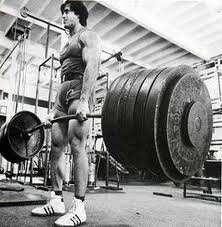
Saturday, October 9, 2010

STRICTLY STRENGTH - Session 1 - Results

You may want to sit down to read this...

The first session of STRICTLY STRENGTH was a major success!!!  People were lifting weights that they never thought they could, and had a hell of a time doing it!  I'll keep this short since there are so many numbers to report, but to all of you that participated in this first session - Y'all rocked it, and I am stoked to have had the opportunity to work with each and every one of you!  Great Work!

 
Jeff Morgan
BS = 205--->255
P = 145--->150
DL = 315--->350
Kris Morgan
BS = 125--->135
P = 60--->65
DL = 165--->185

Nick Blasier
BS = 225--->275
P = 105--->115
DL = 365--->335(injury)

Mary De'Scacchi 
BS = 155--->200
P =60--->70
DL = 215--->235


Sheila De'Scacchi 
BS = 125--->185
P = 70--->70
DL =155--->175


Jeremy Petrie
BS = 225--->(waiting for final results)
P = 135--->(waiting for final results)
DL = 315--->(waiting for final results)


Alan Raphael 
BS = 285--->325
P = 145--->165
DL = 355--->400


 Jeff Blaylock(The price of VICTORY!)
BS = 190--->205
P = 115--->125
DL = 285--->315


Diana Gongora
BS = 125--->(restriction on squats)
P =70--->70
DL = 165--->180


Jarrrett Webb
BS =135--->165
P = 105--->105
DL = 165--->215


Dave Re
BS = 345--->345
P = 175--->175
DL = 365--->385


Aaron Marco
BS = 215--->255
P = 135--->155
DL = 275--->335


Alex Hitzelberg
BS = 265--->265(EASY!!!)
P = 135--->130
DL = 315--->345


David B
BS = (stay tuned for results)
P =  (stay tuned for results)
DL = (stay tuned for results) 

Marsha 
BS = 125--->(didn't finish program)
P = 50--->(didn't finish program)
DL = 175--->(didn't finish program)


Thursday, October 7, 2010

STRICTLY STRENGTH - Session 2 Sold Out and Ready to Rock!!!


The next 15 individuals have been chosen, and we will be starting session #2 October 19th!  This group is full of studs and studettes who are ready to get strong!  We have several "veterans" returning, some brand new faces, and a past CrossFit Games hopeful!  It's gonna be an awesome 8 weeks...I'm stoked!!!

But before the new session starts, the first session must come to a close.  Tomorrow is the last training session of the first offering, so I will be posting the STRICTLY STRENGTH Crew's numbers soon!  I'll just say that the strength gains are staggering!!!  Stay tuned and prepare to have your mind blown!

Wednesday, September 29, 2010

STRICTLY STRENGTH - Session 2...WHO'S READY?

Here's what y'all have been waiting for....


The end of the first session of STRICTLY STRENGTH in near.  We have one more week of heavy lifting and I am expecting to hand out PR's to everyone!!!  In fact, the majority of the 15 individuals that signed up for the first session have already set new PR's in at least one of their lifts, and some have actually set new PR's in several different lifts!!!  Keep in mind that these performance jumps have come from training just once each week for 8 weeks, AND we haven't even completed the final test - the CrossFit Total!  Crazy Gains!!! 

If the results above aren't enough...the "original 15" now have a great understanding of the intricacies of the heavy lifts, as well as a new-found confidence to step up to BIG weight and not waiver when it's go time!  Sounds pretty good, right?

I have had a waiting list for several weeks now, and many of the "original 15" are returning for more, which means that spots for new members are at a premium!!!  If you are looking to make big gains in your overall strength, you need to take action NOW!!!  

I am opening 8 slots for the second session of STRICTLY STRENGTH.
The next session begins Monday, October 18th.  
All of the program details can be found HERE.
  
Once you've read through the program details, send me an email showing your interest.  Be sure to include the days and times that work best for you(no promises you'll get it), as well as if you already have a group of 3.

I look forward to hearing from you soon!

Friday, September 24, 2010

BREAKING DOWN THE SQUAT....AGAIN.

This blog was inspired by one of your peers, Dave Re.  During a STRICTLY STRENGTH session, Dave asked me about the role of the adductor group when squatting.  We briefly discussed the general action of these 5 muscles(adductor magnus, add. longus, add. brevis, pectineus, and gracilis), but I wanted to dive a little deeper in hopes of shedding a little more light on the many intricacies of the squat.

Before we get too far ahead of ourselves, we need to understand the anatomy and actual anatomical terms that I will be "throwing" around during this rant...so, here are some of the basics:

ADduction: movement which brings a part of the anatomy closer to the midline of the body. 
Example: start with your arm raised at your side, parallel to the floor.  Now, bring it down, tight to your side.  This is ADduction - you "added" it to your midline.

ABduction:  movement which draws a limb away from the midline of the body.
Example: The act of lifting your arm to the start position in the example above is ABduction.  The arm was ABducted from the midline.

Agonist: is a classification used to describe a muscle that causes specific movement or possibly several movements to occur through the process of its own contraction.(also known as a Prime-Mover)

Antagonist:  is a classification used to describe a muscle that acts in opposition to the specific movement generated by the agonist and is responsible for returning a limb to its initial position.

Eccentric Contraction:  the muscle elongates while under tension due to an opposing force being greater than the force generated by the muscle. Rather than working to pull a joint in the direction of the muscle contraction, the muscle acts to decelerate a movement or otherwise control the repositioning of a load.

As you can probably start to see, all muscles, and therefore, movements, act in pairs.  This is the BIG IDEA of this post, and it is important that you all understand that fact before we move on.  Got it?

I'm sure that y'all have heard, "Push your knees out!", from your coach at least once, right?  There's a reason for our constant barking - we are trying to get you to activate the ABductors as you descend to the bottom of the squat.  This "knees out" movement is generated at the hip with the gluteus medius, gluteus minimus, and a small portion of the gluteus maximus(main action is hip extension) - the prime movers when it comes to ABduction.  Without this muscle activation, the knees tend to collapse inward toward each other, resulting in a painfully awkward attempt to stand back up.  No good!


On the other hand, when this is done correctly, several beneficial things happen:

1. The descent of the squat movement is far more controlled when we concentrate on driving the butt back and knees open due to the properties of the eccentric contraction.  Both the hamstrings and the ADductors are resisting this downward movement = a slow, controlled, and powerful squat!
2.  Because muscles work in pairs(remember?), while we are contracting the gluteus group to generate this hip ABduction, the ADductors are now performing an eccentric contraction to act as a stabilizer during the down phase.  Once full depth is met, the ADductors that are on stretch now snap closed like a bear trap as we initiate the up phase, resulting in an increased force production as we drive out of the "hole".
3.  You receive style points from your coach because you've successfully performed the squat without looking like you had to pee really, really bad.  Always a good thing!


Now that you know the importance of the ADductors and ABDuctors, how do you strengthen them?

Well, to strengthen you ADductors you can simply sit is chair, or better yet, hold an active squat and place your elbows inside of your knees(this may sound familiar to some of you?).  From there, squeeze your knees together and hold that isometric contraction for 10-15sec.  Relax....and repeat 3-5 sets.

For the Abductor group, I recommend lateral band walks.  You can see how to perform this exercise in this STRICTLY STRENGTH video.  Also, the number one thing you can do to help strengthen these ABductor muscles is to PAY ATTENTION!  When you squat, deadlift, lunge, push press, jerk, etc., take responsibility for where your knees go.  Easy!

Go Get 'em!

Wednesday, September 15, 2010

DEADLIFT = FREAKISH STRENGTH

The Deadlift is a seemingly straight-forward exercise.  But sometimes, we can underestimate the amount of focus it takes to perform a perfect rep, and we often forget how much work the body is actually doing for each successful repetition.  This is all compounded when the barbell is loaded for a PR attempt.  So it is extremely important that we understand the mechanics of a proper deadlift so that when we train at relatively lighter weights, we develop extraordinary form!


There are 3 very simple, but integral parts to the starting position of the deadlift, as pointed out by Mark Rippetoe:

1) The back must be locked in extension.
2) The bar must be touching the shins, with the feet lat on the floor.
3) The shoulders must be out in front of the bar so that the shoulder blades are directly above the bar.
These 3 checkpoints are easy enough to follow, but why is it so necessary that we follow this protocol?  
Let's take this one at a time...

These are all the muscles that create a rigid spine, plus some!
1) The back must be locked in extension.
Weightlifting is all about the translation of force when you simplify it.  A well-performed rep is basically the force you apply to a foundation - in this case, the floor - being efficiently translated to the object you're attempting to move - the barbell.  The mechanism by which this energy is translated and transferred to the barbell is a rigid, unified spine.  As we all know, the spine is a collection of many joints.  By design, these joints allow us to move in many different ranges of motion, which is very advantageous in the "day-to-day".  But, when we try to pick something up without locking our back in, energy is lost from one joint to the next, causing a failed rep and an increased risk of injury.  When the spine is pulled into a single, rigid unit, the energy we create is efficiently transferred from floor to bar, and the risk of injury is virtually zero!  Think of the spine(when locked in)as a highly conductive cable for force rather than electricity.  If the spine is not locked in, the energy transfer is broken and weak.  We should get by now, right?  Let's move on...


2) The bar must be touching the shins, with the feet flat on the floor.
This is another very simple, yet often neglected requirement for a solid deadlift.  I know the athletes in my classes probably get sick of me saying, "Make sure the bar is IN CONTACT with your shins!"  But here's the reasoning...
I want you to use your imagination for a second, and picture yourself standing tall and holding a 35# dumbell directly out in front of you with your arm fully extended parallel to the floor.  Got it?  Most of us could handle that, right?  Now, magically, a large fishing net with a 5ft. handle became available.  You have put that same 35# dumbell in the net, and have extended it out in the same fashion as before.  Do you think you could lift it?  Probably not.
This is the basis of the "bar in contact with the shins" rule.  Naturally, due to gravity, objects have more torque acting upon them when they are lifted using a longer lever-arm, which seemingly makes them feel heavier.  Keeping the barbell in contact with your body throughout the movement is yet another way that your application of force is efficiently translated to the object.

3) The shoulders must be out in front of the bar so that the shoulder blades are directly above the bar.

This one is not so easy to understand, but I will give it my best effort and then refer you to Mark Rippetoe's article in the CrossFit Journal for some supplemental reading.
Now that we understand that force is being conducted from the floor, through our legs and hips to our spine, we can go one step further.  The energy we've created is transferred from the spine to the scapulae(shoulder blades), to the arms, and finally to the bar.  So, the shoulder blades are like a translator bridging the gap from one language to another.  When the shoulder blades are actively pulled back and together, the trap muscles are now doing a lot of work stabilizing the shoulder position, as well as assisting other muscles in locking in the spine.  More importantly to note, is the fact that gravity is acting on the bar in a linear fashion - meaning gravity is pulling it straight down to the floor.  Now, to effectively counteract the force of gravity, we must position ourselves so that our force is being translated directly opposite that of gravity - straight above the bar.  Makes sense, right?


Just think.  This whole blog is all about the start of the deadlift!!!  Actually, if you set up properly you've pretty much got it made!  The only thing now is timing and proper muscle activation, all of which happens fairly naturally after the initial pull.  Just stand up and keep the bar tight to the body...

As you can now tell, there is a lot of biomechanics and physics that goes into having a solid understanding of weightlifting.  It is to your advantage, as an athlete, to have some understanding of why we do what we do.  This understanding will lead to increases in weight lifted, guaranteed!!!  Who knew reading could make you physically stronger?  
Go get it!!! 

Wednesday, September 8, 2010

LOW-BAR SQUAT = FREAKISH STRENGTH

Many of you have just finished the CrossFit Total.  How was it?  From what I can tell, nearly everyone that participates in indoor programs PR'd(Personal Record) the deadlift....But how was the squat?!

The back squat is a different kind of animal.  It is far more intimidating than say, the deadlift, because of one obivous reason:  You are under the weight.  When performing the deadlift, there is no risk of being crushed by the weight.  If you are unable to successfully perform the movement, you simply drop the bar - no harm done.  IF the back squat is unsuccessful, it can be a scary and dangerous thing.  But, here's the deal...

The thing that makes the squat intimidating is the same thing that makes it such a powerful and potent tool in the quest to get strong!  The fact that your entire body is loaded with the weight of the barbell initiates an extreme hormonal response that causes positive adaptation in the body - strength and hypertrophy(muscle growth).  Add to that the fact that we are moving a relatively large load through a large range of motion, and the results of training the back squat properly are crazy!!!

So now we have briefly( I emphasize "briefly" because the list is too long to blog about..more to come though.) gone into what makes the back squat such an effective exercise...Let's talk about the additional benefits of learning how to Low-Bar Back Squat. 

The majority of crossfitters squat using a "High-Bar" postition - that is the barbell is racked on top of the traps and shoulders.  The "Low-Bar" position is, as it sounds, loaded lower on the back, below the spine of the scapulae(shoulderblade).  This positioning allows for several very important things to occur during the actual squat movement:
 
1.  Allows for a greater forward lean without the consequence of rolling into the toes, or losing the lift entirely.
2.  This increased forward tilt at the hip allows us to engage the posterior chain muscles(hamstrings, butt, and low back), which is equivalent to calling in your "heavy-hitters".  These are the muscles that get work done!!!
3.  Because we are engaging the big posterior chain muscles, it stops us from using the small, weak anterior muscles that are usually accompanied by heels coming of the floor, drifting into the toes, 
and losing the ability to "drive" out of a stable, strong foundation.

All of this means BIG WEIGHTS!!!  In fact, Coach Mike Winchester used the low-bar squat early last week and PR'd his back squat by 60#!!!  Ridiculous, right?!  I have been transitioning my STRICTLY STRENGTH people from the typical high-bar to low-bar, and their numbers are going through the roof as well!
I'm sure that I have you hooked by now, and you're ready to go try it out, right?  Not so fast!!!  
Take the time and any other means necessary to correctly learn how to perform a Low-Bar Squat.  This blogpost is only a small view of a much bigger picture.  It was not my goal to try to teach you how to LB Squat via blog.  This is something that must be done with supervision and training, and I would not recommend just "giving it a whirl".


Monday, August 30, 2010

THE NEXT LEVEL

I've been dealing with some pretty annoying hip pain for quit a while now, and I knew that several of the CrossFit Central coaches(Crystal Nelson, John Del Peral and Crystal McReynolds) had been seeing Sam Sneed, a certified Active Release Techniques(ART) practitioner, for some of the nagging issues that they had.  Each of them had all been very pleased with the diagnosis, information, and treatment of their aches and pains, so I thought that it would be worth a try.  I was blown away with the results of the very first treatment!!!

Sam was awesome about taking the time to ask and understand what it was that was bothering me, and then continued to visually dissect my movements to get a clear picture of what was the root of the problem.  This is what struck me as being completely different from all the other methods of "rehab" that I'd tried before - He was treating the root cause, not just the symptoms.  

The first session took about an hour, and by the end of it the pain in my hip had gone...I had an understanding of what was going on...I had several exercises and stretches to do on my own, and most importantly, we had developed a game plan to get back me to 100% again.  The whole experience was refreshing and gave me hope that I wouldn't have to deal with this issue for the rest of my life.

The thing is that you don't have to be in pain to benefit from Sam's amazing service.  I have already talked to many of my STRICTLY STRENGTH people about getting into see him simply because with more mobility comes more strength.  For example, if you are unable to get your arms back for a good low-bar back squat, or if you have a difficult time finding the proper position for an Overhead Squat, or if you have trouble getting to the true bottom of your squats - you are limiting your potential in that movement.  

A.R.T. is a hugely beneficial tool that you should all experience at least once, and after the first session, you will be motivated to step it up to the next level.  To get started:

Feel free to contact Sam at 281.772.8163 to schedule an appointment at SicFit Austin.

-OR-

Be sure to let him know I sent you!!!